
TECHNICAL GUIDE
How Much TVL Does an FPV Camera Need: 1200, 1500 or 1800?
TVL is a useful analog-camera specification, but it is not a complete quality rating. Learn what the number means, how the video chain limits visible detail, and how to compare PRBZ 1800TVL with Caddx Ratel Pro 1500TVL fairly.
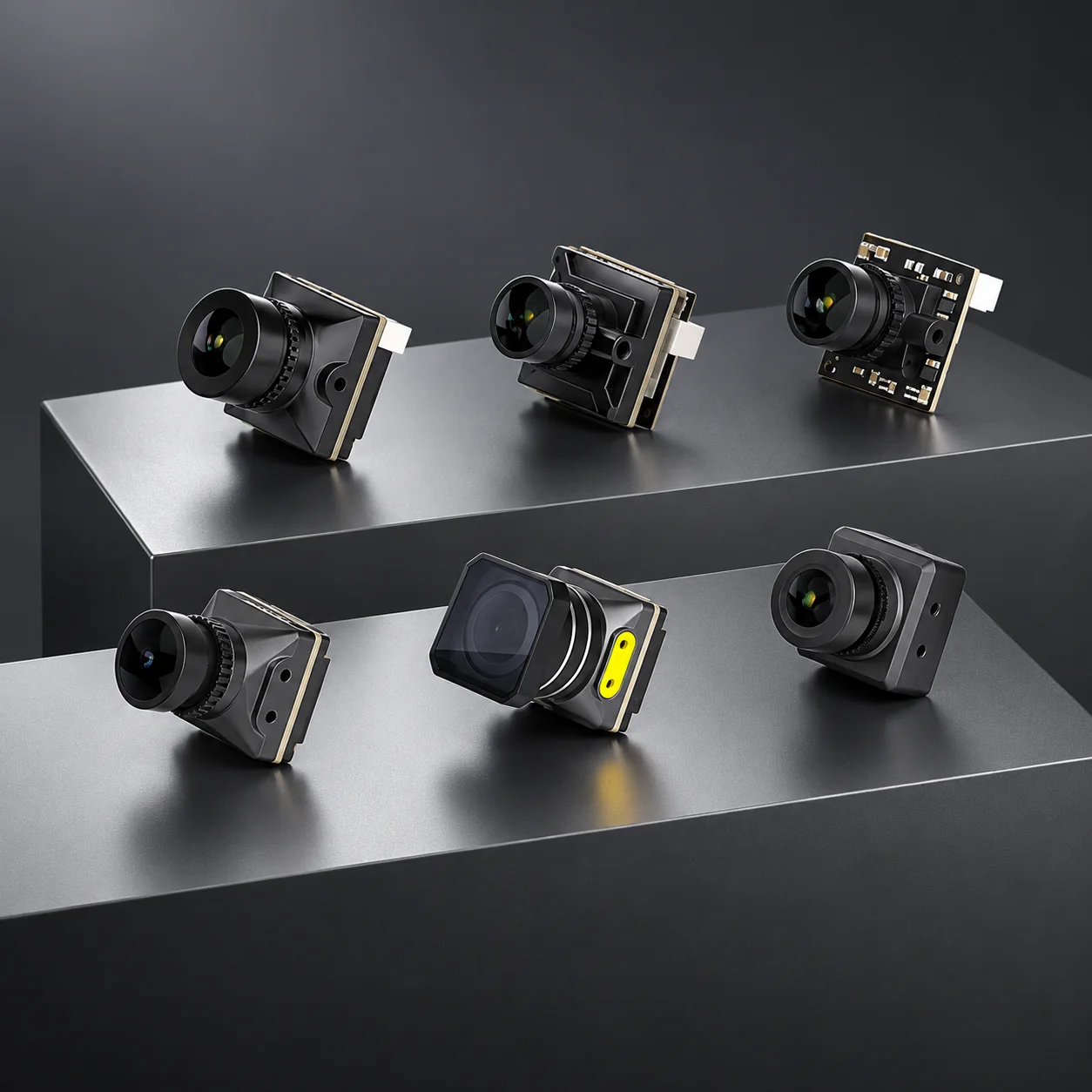
What does TVL mean in an FPV camera?
TVL (television lines) describes how many alternating light and dark lines can be resolved across an image width equal to its height. It is a measure of visual resolution in analog video, not a count of digital pixels or scan lines. [1]
The value is measured with a test pattern whose lines become progressively closer together. In practice, a stated 1200, 1500 or 1800 TVL is a useful model-comparison attribute, not a promise that every display will show that many useful details.
Is 1800 TVL always better than 1500 TVL?
No. A higher TVL is a higher stated detail figure, but it does not guarantee a visibly better picture in your build. The sensor, lens, focus, processing and analog video chain all contribute to the final image.
Analog video has limited bandwidth. If transmission, receiver, DVR or display cannot preserve the source detail, a higher stated TVL will not become visible detail. [2]
Details are listed in this order: How to read it / What it does not prove by itself.
- 1200 TVL: A model’s stated horizontal detail reference / That the image must be poor or worse than every higher-number model
- 1500 TVL: A specification to compare alongside other parameters / That it is always better than 1200 or worse than 1800 in use
- 1800 TVL: A higher stated figure in a specification / That real detail will be 20% better than at 1500 TVL
What limits analog image detail besides TVL?
The whole system determines what you see: optics must resolve fine detail, processing must preserve it, and the analog link must carry it. CVBS is a composite interface that combines information in one signal; the bandwidth and quality of each link affect the result. [1]
- Sensor: size and properties affect detail and low-light behaviour.
- Lens and focus: optical quality, field of view and focus affect visible detail.
- WDR and noise reduction: processing can help in difficult scenes, depending on implementation.
- Lighting: low light can reduce contrast and make small details harder to see.
- Video chain: transmitter, receiver, cables, DVR decoder and display can limit or distort the signal.
How should you compare PRBZ 1800TVL and Caddx Ratel Pro 1500TVL?
FPV Vision lists PRBZ Mini 1800TVL with an analog output, a 1/3-inch CMOS sensor and 19 × 19 × 19 mm dimensions. Caddx specifies 1500 TVL, a 1/1.8-inch sensor, Super WDR, switchable PAL/NTSC and switchable 4:3/16:9 for Ratel Pro. These describe different properties; they do not make one model a technical equivalent of the other. Caddx Ratel Pro specifications.
See the PRBZ Mini vs Caddx Ratel Pro comparison for prices, dimensions and confirmed details. Product pages: PRBZ 1800TVL and Caddx Ratel Pro.
How do you choose 1200, 1500 or 1800 TVL for a build?
Start with conditions and compatibility, then treat TVL as one row in a comparison. The most useful test is image samples made with the same settings, known equipment and comparable lighting.
- Check the analog format and compatibility across the system.
- Compare dimensions, mounting, lens and documented power range.
- For low light, assess the sensor, lens and verified examples—not only Lux or TVL.
- Compare the details you need on the same receiver and display.
- If comparable footage is unavailable, treat TVL as a stated specification only.
For the broader selection process, read the FPV camera selection guide; for low-light technologies, see Starlight, IR and thermal imaging.
Sources and notes
External sources support the technical explanations; check FPV Vision product specifications on the relevant model page.
Need help? Contact FPV Vision. All materials.