
ARTICLE
How to Choose an FPV Camera: TVL, Lux, WDR and PAL/NTSC
It is easy to get lost in FPV camera specifications: 1500 or 1800 TVL, Lux, WDR, PAL or NTSC. This guide explains what these terms mean, what they affect in practice and how to compare cameras for a specific task.
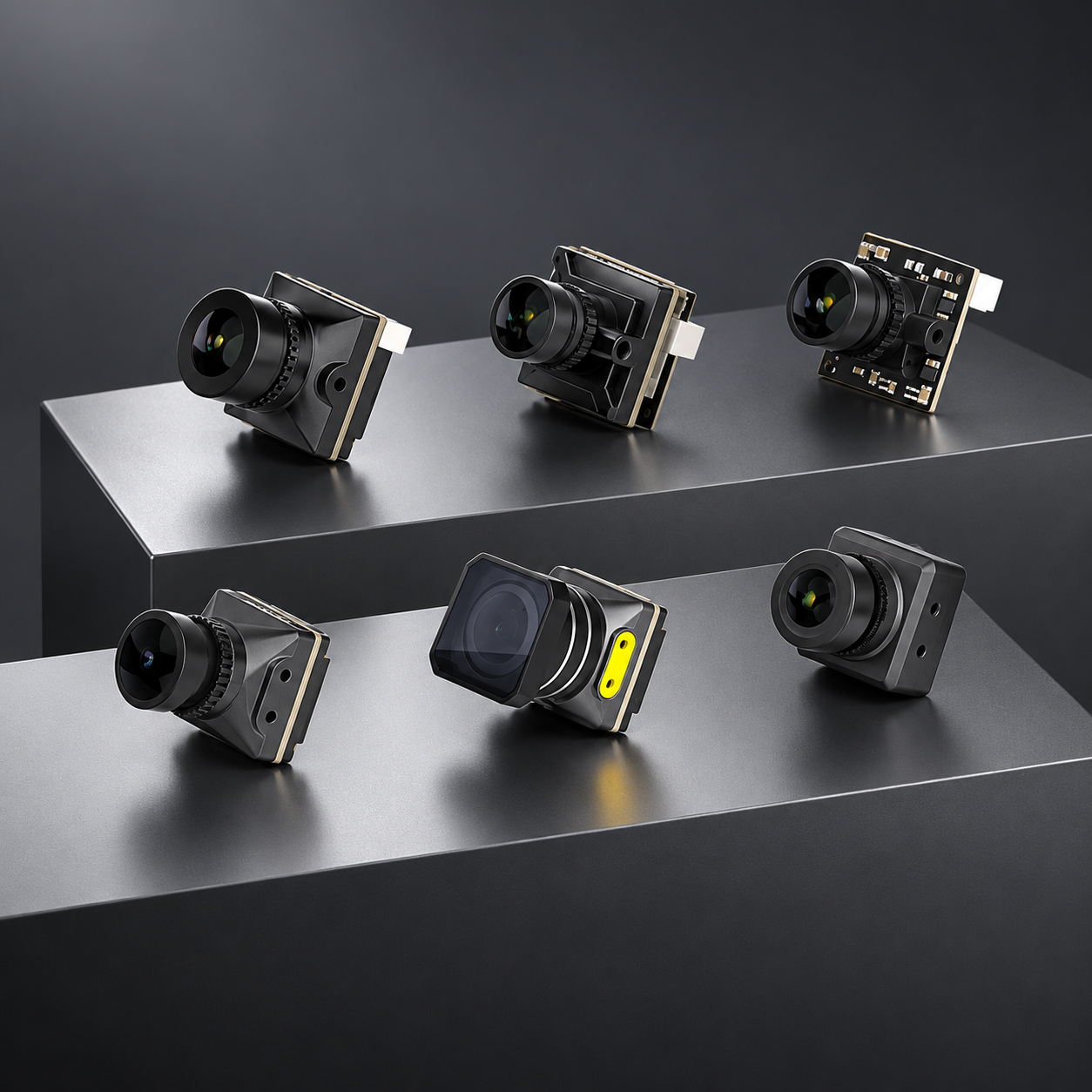
What to Look for When Choosing an FPV Camera
Start with the conditions in which the camera will operate. This makes it easier to check compatibility and rule out models that do not fit your build.
- Will it be used in daylight or low light?
- How important is it to retain detail against a bright sky or another light source?
- Which video format does your system support?
- What camera dimensions fit your build?
- What power supply is available?
- What field of view does your task require?
- Are real photos or footage available from this camera?
What Does TVL Mean in an FPV Camera?
TVL describes the level of detail an analogue camera can reproduce. A higher stated value may mean more detail, but only if the rest of the video system can carry it.
Technically, TVL (television lines) describes how many alternating light and dark vertical lines can be distinguished across a picture width normalised to its height. It is not the number of scan lines or digital pixels. [1]
1500 TVL or 1800 TVL: Which Should You Choose?
On paper, 1800 TVL indicates a higher stated resolution than 1500 TVL. The result also depends on the sensor, optics and image processing, signal transmission, receiver, and display or DVR.
When comparing two models, look at real footage recorded in conditions similar to yours.
What Does Lux Mean in FPV Camera Specifications?
Lux (lx) is a unit of illuminance. The figure minimum illumination states the light level at which a camera is specified to produce an image. The result depends on the measurement conditions. [2]
A 0.001 Lux rating on one camera cannot automatically be considered better than 0.01 Lux on another. Comparisons are affected by the lens and its F-number, gain, exposure time and the criteria used to judge the image. [3]
How to Choose a Camera for Low Light
Compare the stated Lux figure with sensor and lens information, gain modes and real photos or footage. A fair comparison requires the same lighting conditions and known settings.
What Is WDR for in an FPV Camera?
A frame can contain a bright sky and much darker ground at the same time. Without enough dynamic range, the sky may be overexposed or shadow detail may be lost.
WDR means Wide Dynamic Range — a way of handling a scene with a large difference in brightness. Implementation varies by camera, so the WDR label alone does not guarantee a consistent result. [4]
When Is WDR Especially Useful?
Consider WDR when the camera sees a bright sky and dark ground, moves from shade into sunlight, faces the sun or another bright source, or is used in a high-contrast scene. Check the actual image to see whether the details you need remain visible.
PAL or NTSC for FPV?
Neither PAL nor NTSC is universally better. Choose the format that is compatible with the rest of your video system.
PAL and NTSC are different analogue video standards. Traditional systems are commonly described as PAL 625/50 and NTSC-M 525/59.94. [5]
Check compatibility between the camera, transmitter and receiver, goggles or monitor, and DVR. If the camera can switch between PAL and NTSC, choose the mode supported by the entire system. The PAL/NTSC guide provides a practical compatibility checklist. [6]
How to Compare Two FPV Cameras
- Define the operating conditions. Daylight, dusk, low light or high contrast.
- Check compatibility. Video format, power, dimensions and connections.
- Compare confirmed specifications. TVL, Lux, WDR, sensor, optics and field of view, where documented.
- Review real footage. Ideally, compare the same scene recorded under the same conditions.
- Test the camera in your system. If a sample is available, testing it is more reliable than choosing from specifications alone.
Common Mistakes When Choosing an FPV Camera
- “More TVL always means a better camera”
- No. TVL describes detail in an analogue image, not the overall quality of the system.
- “The lowest Lux rating means the best night camera”
- No. You need to know the measurement conditions and review the actual image.
- “WDR automatically handles any contrast”
- No. WDR implementation and results vary between cameras.
- “PAL is always better than NTSC”
- No. Choose the format based on compatibility across all devices.
- “Comparing the box specifications is enough”
- No. The camera is part of an FPV system, so compatibility and the image in the actual build matter.
BEFORE YOU CHOOSE
Quick checklist
- Which video format does my system support?
- What lighting conditions will the camera be used in?
- Do I need WDR?
- What field of view do I need?
- Are the dimensions and power requirements compatible?
- Is real footage from the camera available?
- Can I test a sample before placing a large order?
Test sample availability depends on current FPV Vision arrangements; please confirm before ordering.
FPV VISION RANGE
FPV Vision Cameras
FPV Vision offers analogue FPV cameras for different conditions and tasks. Check the current specifications for the specific model before ordering.
Sources and notes
Sources explain technical terms and standards; they do not verify specifications for specific FPV cameras.
- Analog Devices — Video Basics: Analog Video. TV lines and analogue video.
- CIE International Lighting Vocabulary — Illuminance. Definitions of illuminance and lux.
- Sony — Analog Fixed Cameras, technical specifications (PDF). Example of minimum-illumination measurement conditions.
- Sony Semiconductor Solutions — High Dynamic Range Technology. About scenes with a wide brightness range.
- ITU-R Recommendation BT.470-7 — Conventional analogue television systems.
- ITU-R Recommendation BT.1700 — Characteristics of composite video signals.
Need help? Contact FPV Vision.